

WAVE THEORY EXPLAINED THROU... (WAVE)

0xcc5bda1deeacfde96f21d0cd23d7b590ada5a7b3
Presale Live
Started at Apr 3, 2026
About WAVE THEORY EXPLAINED THROU...
The Core Concepts (MVW/Wave Mechanics)
De Broglie Hypothesis (
): Matter particles, such as electrons, behave as waves. The wavelength (
) is inversely proportional to momentum (
), where
is Planck's constant.
Standing Waves: For an electron to exist in a stable state in hydrogen, it must form a standing wave around the nucleus. This implies that a whole number of wavelengths must fit along the circumference of the orbit (
, where
).
Wavefunction and Probability: The electron's position is defined by a complex mathematical function
derived from the Schrödinger equation. The square of this function (
) gives the probability density of finding the electron at a specific point.
Wikipedia
+4
2. Explanation through the Hydrogen Atom
The hydrogen atom serves as the primary test for wave theory because it has only one electron, allowing for an exact solution of the Schrödinger equation.
Quantized Energy Levels (
): Wave mechanics shows that the electron can only exist in certain discrete energy states, not at any arbitrary energy. These states are characterized by the principal quantum number (
).
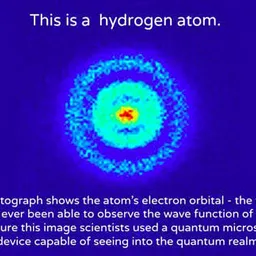
Electron Clouds/Orbitals: Instead of fixed elliptical paths, the electron exists in a "cloud" of probability, often visualized as a "1s" orbital (sphere) for the ground state.
Nodes: The wave function can have nodes—regions where the probability density is zero. A 1s state has no radial nodes, but higher states (2s, 3p) have nodes, meaning the electron is unlikely to be found there.
Spectral Lines: When an electron moves from a high-energy wave state (
) to a lower-energy state (
), it emits a photon. The energy difference (
) corresponds exactly to the specific, discrete wavelengths observed in the hydrogen spectrum, explaining the Balmer and Lyman series.
Wikipedia
+4
3. Key Differences from Bohr Theory
While Bohr's theory correctly predicted energy levels by assuming quantized angular momentum (
), it treated the electron as a classical particle. Wave theory improves this by:
Removing Classical Orbits: It abandons the idea of well-defined electron trajectories.
Introducing 3D Probability: It describes the electron's position using 3D probability clouds (orbitals) rather than 2D circular paths.
Explaining Fine Structure: It accounts for the wave-like properties that cause slight splitting in spectral lines that Bohr's model could not explain.
Lumen Learning
+2
The wave theory provides a more complete description of the hydrogen atom by showing that atomic structure is dictated by wave mechanics and the probability of finding the electron.
Wikipedia
+1
De Broglie Hypothesis (
): Matter particles, such as electrons, behave as waves. The wavelength (
) is inversely proportional to momentum (
), where
is Planck's constant.
Standing Waves: For an electron to exist in a stable state in hydrogen, it must form a standing wave around the nucleus. This implies that a whole number of wavelengths must fit along the circumference of the orbit (
, where
).
Wavefunction and Probability: The electron's position is defined by a complex mathematical function
derived from the Schrödinger equation. The square of this function (
) gives the probability density of finding the electron at a specific point.
Wikipedia
+4
2. Explanation through the Hydrogen Atom
The hydrogen atom serves as the primary test for wave theory because it has only one electron, allowing for an exact solution of the Schrödinger equation.
Quantized Energy Levels (
): Wave mechanics shows that the electron can only exist in certain discrete energy states, not at any arbitrary energy. These states are characterized by the principal quantum number (
).
Electron Clouds/Orbitals: Instead of fixed elliptical paths, the electron exists in a "cloud" of probability, often visualized as a "1s" orbital (sphere) for the ground state.
Nodes: The wave function can have nodes—regions where the probability density is zero. A 1s state has no radial nodes, but higher states (2s, 3p) have nodes, meaning the electron is unlikely to be found there.
Spectral Lines: When an electron moves from a high-energy wave state (
) to a lower-energy state (
), it emits a photon. The energy difference (
) corresponds exactly to the specific, discrete wavelengths observed in the hydrogen spectrum, explaining the Balmer and Lyman series.
Wikipedia
+4
3. Key Differences from Bohr Theory
While Bohr's theory correctly predicted energy levels by assuming quantized angular momentum (
), it treated the electron as a classical particle. Wave theory improves this by:
Removing Classical Orbits: It abandons the idea of well-defined electron trajectories.
Introducing 3D Probability: It describes the electron's position using 3D probability clouds (orbitals) rather than 2D circular paths.
Explaining Fine Structure: It accounts for the wave-like properties that cause slight splitting in spectral lines that Bohr's model could not explain.
Lumen Learning
+2
The wave theory provides a more complete description of the hydrogen atom by showing that atomic structure is dictated by wave mechanics and the probability of finding the electron.
Wikipedia
+1
In case of missing or misleading information pleaseID: 225175

0

0

0
 Check Contract
 WAVE THEORY EXPLAINED THROU... FAQ
Is WAVE THEORY EXPLAINED THROU... a scam?
What is WAVE THEORY EXPLAINED THROU... contract address?
Launched on Apr 3, 2026
In case of missing or misleading information please