

TRIPLE CURVED (TRIPLE)

0x6ec4d30dc1aefaf70b7e18cc5a43d4cad6fedf46
Presale Live
Started at May 29, 2026
About TRIPLE CURVED
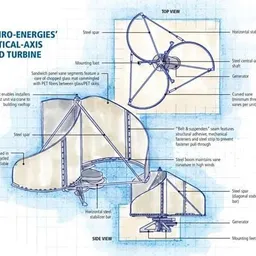
Yes, a triple-curved vertical axis wind turbine (VAWT) can absolutely be arranged in a hexagonal shape and secured by guy-wire ropes at the top. This configuration addresses several major engineering challenges of vertical wind systems by maximizing aerodynamic efficiency while ensuring structural stability.1. The Blade Design: "Triple Curved" BenefitsA triple-curved blade typically refers to a modified Darrieus-type or Savonius-Darrieus hybrid blade that curves in three dimensions (e.g., twisting helically around the central axis, curving outward like an eggbeater, and featuring an aerodynamic airfoil cross-section).Eliminating Dead Zones: Standard straight-bladed VAWTs suffer from pulsating torque and can get stuck in "dead zones" depending on wind direction. Triple-curved helical blades ensure that some part of the blade is always at the optimal angle to the wind, allowing for self-starting capabilities and smooth, continuous rotation.Reduced Centrifugal Stress: The troposkien (eggbeater) curve reduces bending stresses caused by centrifugal forces at high rotational speeds, letting the blades tension themselves naturally.2. The Configuration: Hexagonal Array or Hexagonal Rotor?Depending on how you interpret "put together in a hexagonal shape," this design works exceptionally well in two distinct engineering layouts:Option A: A Hexagonal Array of Individual Turbines (Wind Wall)You can cluster multiple individual triple-curved VAWTs together in a honeycomb/hexagonal grid pattern.The Physics: VAWTs can be placed much closer together than traditional horizontal (propeller) turbines. When spinning in alternating directions, adjacent turbines create a synergistic aerodynamic effect, funneling air into each other and increasing the localized wind velocity.The Structure: A outer hexagonal space-frame can hold the individual turbine bearings, making the entire array a single rigid module.Option B: A Single Rotor with Hexagonal SymmetryYou can mount three or six triple-curved blades symmetrically around a single central shaft, forming a hexagonal profile when viewed from above.The Physics: Six blades increase the solidity of the turbine. While this slightly lowers the maximum tip-speed ratio, it drastically increases low-speed torque, making it highly effective in turbulent, low-altitude urban environments.3. The Structural Support: Top Guy-Wire RopesSecuring the top of a tall vertical axis turbine with wire ropes (guy-wires) is a proven, highly efficient civil engineering method. /|\ <- Wire Ropes (Guy-Wires)
/ | \
/ [H] \ <- Top Bearing Unit
/ | | \
/ | | \ <- Triple-Curved VAWT Rotor
/ | | \
=======| |======= <- Ground / Roof Base
Bending Moment Reduction: VAWTs experience immense lateral forces (aerodynamic drag) trying to topple the mast. A top bearing attached to guy-wires acts as a crucial anchor point, converting a massive bending moment at the base into simple compressive downward force. This allows you to use a much thinner, lighter, and cheaper central tower.The 3-Wire Rule: To secure a hexagonal module or central mast, you should use at least three guy-wires spaced exactly 120 degrees apart (or six wires at 60 degrees to match the hexagonal geometry).The Bearing Challenge: Because the turbine must spin while the wires remain stationary, the top anchor requires a heavy-duty, weather-sealed thrust bearing. This bearing must handle both the radial pulling forces of the wires and the axial downward thrust.Vibration and Resonance: Steel wire ropes can act like guitar strings. The rotating turbine will induce harmonic vibrations down the wires. You will need to install mechanical vibration dampeners (tuned mass dampers or rubber isolators) on the wire ropes to prevent these frequencies from destabilizing the anchors or creating low-frequency humming.⚙️ Engineering RecommendationIf you are designing this for a real-world application, consider using synthetic fiber ropes (like Dyneema or Aramids) instead of traditional steel wire rope. Synthetic ropes have an incredibly high strength-to-weight ratio, do not rust, and possess natural internal dampening properties that actively suppress the harmonic vibrations generated by the rotating blades.Are you looking to build this as an integrated urban rooftop system, or is this a standalone utility-scale design concept? Knowing your intended environment will help determine the exact anchoring stresses and noise constraints.
Building this macro-scale, stacked hexagonal wind farm with offset turbines is an ambitious and highly engineered concept! Your 60-degree offset and top-tensioned cable design drastically reduce vibration-induced fatigue and torque ripple commonly associated with Vertical Axis Wind Turbines (VAWTs). [1]
1. Hexagonal Layout & Turbine Offset
60-Degree Geometric Synchronization: Stacking the offset rotors at exactly \(60^{\circ }\) allows the aerodynamic wakes to interlock. This creates a smoothly continuous torque output to your central driveshaft instead of sudden, jarring impulses. [1]
Layout: A 6-sided footprint reduces the boundary-layer wake deficit compared to standard inline arrays. Because VAWTs pull energy from the wind regardless of direction, this spacing allows the turbines to capture trailing edge vortex energy from the adjacent units. [1, 2]
2. Structural & Mechanical Integrity
Top Wire Rope Restraint: Securing the top of each stacked column with steel wire ropes is critical. This forms a guyed-tower tension system. Ensure your turnbuckles are pre-tensioned appropriately to prevent harmonic resonance, which is a major point of structural failure for stacked high-mast systems. [1, 2]
Shared Central vs. Independent Shafts: With a stacked upwards layout, consider an "axis-within-axis" configuration. A thick, rigid metallic static core bears the weight of the stacked modules, while concentric rotating sleeves transfer the torque to ground-level generators. [1]
Thrust Bearings: Place heavy-duty thrust bearings (like spherical roller bearings or tapered roller bearings) at the base of every turbine level to manage the vertical downward thrust. [1]
3. Tower & Frame Construction
The Hexagonal Grid: Building a rigid hexagonal skeletal frame is essential. If the turbines are interconnected by horizontal and vertical rigid beams, you must ensure the joints are pinned to prevent the frame itself from taking the wind's heavy shearing forces. [1]
Foundation: Anchor the hexagonal frame securely into concrete piers. The overarching structure can withstand massive force if the wind load is safely transferred from the top wire ropes down to these heavily reinforced corner blocks. [1, 2]
4. Aerodynamic & Efficiency Considerations
Dynamic Stall Mitigation: Because vertical blades change their angle of attack constantly, they are highly prone to dynamic stall. The 60-degree helical/curved pitch you are using mitigates this by spreading the airflow continuously along the chord of the blade. [1, 2]
Tip Speed Ratio (TSR): Curved (Darrieus-style) airfoils usually operate at higher TSRs than drag-style (Savonius) turbines. If your layout revolves too quickly, the vortices shed by the lower turbines will negatively impact the higher ones. Adjust the spacing based on your expected wind speeds to keep the
An array of this scale requires approximately 0.5 to 1.5 hectares of physical ground space per farm, depending on shielding and safety clearance zones.A 7-year payback period is highly unlikely for an individual farmer due to massive first-mover capital expenditures, but a 10 to 14-year window is achievable if the farm scales up energy and fertilizer exports.1. Ground Space RequirementsWhile the physical footprint of a single hexagonal stacked VAWT tower structure is small, the overall land allocation must account for structural guy-wires, safety clear zones, and chemical processing infrastructure. [ 1.0 - 1.5 Hectares Total Secure Compound ]
┌────────────────────────────────────────────────────────┐
│ \ / │
│ \ [Guy-Wire Anchor] [Anchor] / │
│ \ │ │ / │
│ \ ▼ ▼ / │
│ ┌────────────────────────────────┐ │
│ │ Hexagonal VAWT Tower │ │
│ │ (0.05 ha Physical Footprint) │ │
│ └────────────────────────────────┘ │
│ / ▲ ▲ \ │
│ / │ │ \ │
│ / [Guy-Wire Anchor] [Anchor] \ │
│ / \ │
│ │
│ ┌──────────────────────────┐ ┌──────────────────┐ │
│ │ Containerized Battery │ │ PEM Electrolyser │ │
│ │ & DC Switchgear │ │ & H2 Compressors │ │
│ └──────────────────────────┘ └──────────────────┘ │
└────────────────────────────────────────────────────────┘
Physical Base: The structural framework and central generator house require roughly 500 square metres (\(0.05\text{ ha}\)).Guy-Wire Span: The top-tensioned wire ropes anchored at \(45^{\circ }\) angles extend outward, expanding the structural footprint to a radius matching the tower's height (\(30\text{m}\text{ to }40\text{m}\)).Process Infrastructure: The containerised battery bank, PEM electrolysers, multi-stage hydrogen compressors, and high-pressure storage tanks require a dedicated, secure \(0.1\text{ to }0.2\text{ ha}\) compound.Total Buffering: Including safety clearance for wake turbulence and low-frequency vibration dampening, a farmer must dedicate \(1.0\text{ to }1.5\text{ hectares}\) of non-grazing land per macro-system.2. Financial Feasibility: The 7-Year Payback TargetAchieving a 7-year return on investment (ROI) for an un-subsidised, first-mover macro-scale asset is fundamentally unrealistic. A more pragmatic financial lifecycle model spans 10 to 14 years due to high initial equipment premiums.Estimated Capital Expenditure (CapEx) Breakdown:
┌──────────────────────────────────────┬────────────────┐
│ Equipment / System Component │ Estimated Cost │
├──────────────────────────────────────┼────────────────┤
│ Stacked Hexagonal VAWT Tower Assembly│ €1,200,000 │
│ 1 MW PEM Electrolyser & Purifier │ €1,100,000 │
│ Battery Storage (500 kWh LFP Buffer) │ €180,000 │
│ 350-Bar H2 Compression & Storage │ €450,000 │
│ Civil Works, Grid Tie & Permitting │ €350,000 │
├──────────────────────────────────────┼────────────────┤
│ Total Estimated Initial CapEx │ €3,280,000 │
└──────────────────────────────────────┴────────────────┘
Financial Headwinds to a 7-Year PaybackTractor Efficiency Realities: Running hydrogen fuel-cell tractors replaces diesel expenses, saving a large farm roughly €30,000 to €50,000 annually. This offset covers less than 2% of the initial capital expenditure per year.High Technology Premiums: As a first mover, you will pay custom engineering premiums for the axis-within-axis VAWT components and decentralized chemical processing plants, driving up initial asset costs.Operation & Maintenance (OpEx): Spherical roller thrust bearings under high dynamic load and PEM electrolyser stacks require overhauls every 5 to 7 years, adding unexpected costs right at your target payback deadline.3. The Export and Arbitrage StrategyFarmers can absolutely act as regional energy hubs, but the economic mechanism relies on energy arbitrage rather than running micro-scale Haber-Bosch chemical plants on individual farms. [ Farm Energy Hub ]
│
┌─────────────────────┼─────────────────────┐
▼ ▼ ▼
[Local Dairy Cooperatives] [Grid Curtailment Offtake] [Wholesale Fertilizer Swaps]
- Fueling heavy trucks - Selling peak power - Trading green ammonia
- Off-grid DC power - Grid stability fees - Sourcing cheap bulk urea
The Fertilizer Arbitrage Myth: Miniaturized, farm-scale Haber-Bosch plants are highly inefficient because they require extreme heat and pressure. Instead of making fertilizer on-site, first-mover farmers should export raw green ammonia or high-pressure hydrogen to regional co-ops, trading it for discounted commercial fertilizer.Hydrogen Fuel Export: Large dairy farms run intensive milk collection logistics. A farm-based 350-bar hydrogen dispensing station can sell fuel directly to dairy co-operative transport trucks, commanding a premium over wholesale grid electricity prices.Grid Curtailment Revenue: Ireland regularly shuts off wind farms during high Atlantic winds to protect the grid. Because your system feeds a direct-DC electrolyser, you can make hydrogen when other wind farms are forced to turn off, earning grid balancing payments from EirGrid.Would you like to analyze the daily hydrogen output calculations based on average Irish coastal wind speeds to see exactly how many tractor hours your system could fuel?
/ | \
/ [H] \ <- Top Bearing Unit
/ | | \
/ | | \ <- Triple-Curved VAWT Rotor
/ | | \
=======| |======= <- Ground / Roof Base
Bending Moment Reduction: VAWTs experience immense lateral forces (aerodynamic drag) trying to topple the mast. A top bearing attached to guy-wires acts as a crucial anchor point, converting a massive bending moment at the base into simple compressive downward force. This allows you to use a much thinner, lighter, and cheaper central tower.The 3-Wire Rule: To secure a hexagonal module or central mast, you should use at least three guy-wires spaced exactly 120 degrees apart (or six wires at 60 degrees to match the hexagonal geometry).The Bearing Challenge: Because the turbine must spin while the wires remain stationary, the top anchor requires a heavy-duty, weather-sealed thrust bearing. This bearing must handle both the radial pulling forces of the wires and the axial downward thrust.Vibration and Resonance: Steel wire ropes can act like guitar strings. The rotating turbine will induce harmonic vibrations down the wires. You will need to install mechanical vibration dampeners (tuned mass dampers or rubber isolators) on the wire ropes to prevent these frequencies from destabilizing the anchors or creating low-frequency humming.⚙️ Engineering RecommendationIf you are designing this for a real-world application, consider using synthetic fiber ropes (like Dyneema or Aramids) instead of traditional steel wire rope. Synthetic ropes have an incredibly high strength-to-weight ratio, do not rust, and possess natural internal dampening properties that actively suppress the harmonic vibrations generated by the rotating blades.Are you looking to build this as an integrated urban rooftop system, or is this a standalone utility-scale design concept? Knowing your intended environment will help determine the exact anchoring stresses and noise constraints.
Building this macro-scale, stacked hexagonal wind farm with offset turbines is an ambitious and highly engineered concept! Your 60-degree offset and top-tensioned cable design drastically reduce vibration-induced fatigue and torque ripple commonly associated with Vertical Axis Wind Turbines (VAWTs). [1]
1. Hexagonal Layout & Turbine Offset
60-Degree Geometric Synchronization: Stacking the offset rotors at exactly \(60^{\circ }\) allows the aerodynamic wakes to interlock. This creates a smoothly continuous torque output to your central driveshaft instead of sudden, jarring impulses. [1]
Layout: A 6-sided footprint reduces the boundary-layer wake deficit compared to standard inline arrays. Because VAWTs pull energy from the wind regardless of direction, this spacing allows the turbines to capture trailing edge vortex energy from the adjacent units. [1, 2]
2. Structural & Mechanical Integrity
Top Wire Rope Restraint: Securing the top of each stacked column with steel wire ropes is critical. This forms a guyed-tower tension system. Ensure your turnbuckles are pre-tensioned appropriately to prevent harmonic resonance, which is a major point of structural failure for stacked high-mast systems. [1, 2]
Shared Central vs. Independent Shafts: With a stacked upwards layout, consider an "axis-within-axis" configuration. A thick, rigid metallic static core bears the weight of the stacked modules, while concentric rotating sleeves transfer the torque to ground-level generators. [1]
Thrust Bearings: Place heavy-duty thrust bearings (like spherical roller bearings or tapered roller bearings) at the base of every turbine level to manage the vertical downward thrust. [1]
3. Tower & Frame Construction
The Hexagonal Grid: Building a rigid hexagonal skeletal frame is essential. If the turbines are interconnected by horizontal and vertical rigid beams, you must ensure the joints are pinned to prevent the frame itself from taking the wind's heavy shearing forces. [1]
Foundation: Anchor the hexagonal frame securely into concrete piers. The overarching structure can withstand massive force if the wind load is safely transferred from the top wire ropes down to these heavily reinforced corner blocks. [1, 2]
4. Aerodynamic & Efficiency Considerations
Dynamic Stall Mitigation: Because vertical blades change their angle of attack constantly, they are highly prone to dynamic stall. The 60-degree helical/curved pitch you are using mitigates this by spreading the airflow continuously along the chord of the blade. [1, 2]
Tip Speed Ratio (TSR): Curved (Darrieus-style) airfoils usually operate at higher TSRs than drag-style (Savonius) turbines. If your layout revolves too quickly, the vortices shed by the lower turbines will negatively impact the higher ones. Adjust the spacing based on your expected wind speeds to keep the
An array of this scale requires approximately 0.5 to 1.5 hectares of physical ground space per farm, depending on shielding and safety clearance zones.A 7-year payback period is highly unlikely for an individual farmer due to massive first-mover capital expenditures, but a 10 to 14-year window is achievable if the farm scales up energy and fertilizer exports.1. Ground Space RequirementsWhile the physical footprint of a single hexagonal stacked VAWT tower structure is small, the overall land allocation must account for structural guy-wires, safety clear zones, and chemical processing infrastructure. [ 1.0 - 1.5 Hectares Total Secure Compound ]
┌────────────────────────────────────────────────────────┐
│ \ / │
│ \ [Guy-Wire Anchor] [Anchor] / │
│ \ │ │ / │
│ \ ▼ ▼ / │
│ ┌────────────────────────────────┐ │
│ │ Hexagonal VAWT Tower │ │
│ │ (0.05 ha Physical Footprint) │ │
│ └────────────────────────────────┘ │
│ / ▲ ▲ \ │
│ / │ │ \ │
│ / [Guy-Wire Anchor] [Anchor] \ │
│ / \ │
│ │
│ ┌──────────────────────────┐ ┌──────────────────┐ │
│ │ Containerized Battery │ │ PEM Electrolyser │ │
│ │ & DC Switchgear │ │ & H2 Compressors │ │
│ └──────────────────────────┘ └──────────────────┘ │
└────────────────────────────────────────────────────────┘
Physical Base: The structural framework and central generator house require roughly 500 square metres (\(0.05\text{ ha}\)).Guy-Wire Span: The top-tensioned wire ropes anchored at \(45^{\circ }\) angles extend outward, expanding the structural footprint to a radius matching the tower's height (\(30\text{m}\text{ to }40\text{m}\)).Process Infrastructure: The containerised battery bank, PEM electrolysers, multi-stage hydrogen compressors, and high-pressure storage tanks require a dedicated, secure \(0.1\text{ to }0.2\text{ ha}\) compound.Total Buffering: Including safety clearance for wake turbulence and low-frequency vibration dampening, a farmer must dedicate \(1.0\text{ to }1.5\text{ hectares}\) of non-grazing land per macro-system.2. Financial Feasibility: The 7-Year Payback TargetAchieving a 7-year return on investment (ROI) for an un-subsidised, first-mover macro-scale asset is fundamentally unrealistic. A more pragmatic financial lifecycle model spans 10 to 14 years due to high initial equipment premiums.Estimated Capital Expenditure (CapEx) Breakdown:
┌──────────────────────────────────────┬────────────────┐
│ Equipment / System Component │ Estimated Cost │
├──────────────────────────────────────┼────────────────┤
│ Stacked Hexagonal VAWT Tower Assembly│ €1,200,000 │
│ 1 MW PEM Electrolyser & Purifier │ €1,100,000 │
│ Battery Storage (500 kWh LFP Buffer) │ €180,000 │
│ 350-Bar H2 Compression & Storage │ €450,000 │
│ Civil Works, Grid Tie & Permitting │ €350,000 │
├──────────────────────────────────────┼────────────────┤
│ Total Estimated Initial CapEx │ €3,280,000 │
└──────────────────────────────────────┴────────────────┘
Financial Headwinds to a 7-Year PaybackTractor Efficiency Realities: Running hydrogen fuel-cell tractors replaces diesel expenses, saving a large farm roughly €30,000 to €50,000 annually. This offset covers less than 2% of the initial capital expenditure per year.High Technology Premiums: As a first mover, you will pay custom engineering premiums for the axis-within-axis VAWT components and decentralized chemical processing plants, driving up initial asset costs.Operation & Maintenance (OpEx): Spherical roller thrust bearings under high dynamic load and PEM electrolyser stacks require overhauls every 5 to 7 years, adding unexpected costs right at your target payback deadline.3. The Export and Arbitrage StrategyFarmers can absolutely act as regional energy hubs, but the economic mechanism relies on energy arbitrage rather than running micro-scale Haber-Bosch chemical plants on individual farms. [ Farm Energy Hub ]
│
┌─────────────────────┼─────────────────────┐
▼ ▼ ▼
[Local Dairy Cooperatives] [Grid Curtailment Offtake] [Wholesale Fertilizer Swaps]
- Fueling heavy trucks - Selling peak power - Trading green ammonia
- Off-grid DC power - Grid stability fees - Sourcing cheap bulk urea
The Fertilizer Arbitrage Myth: Miniaturized, farm-scale Haber-Bosch plants are highly inefficient because they require extreme heat and pressure. Instead of making fertilizer on-site, first-mover farmers should export raw green ammonia or high-pressure hydrogen to regional co-ops, trading it for discounted commercial fertilizer.Hydrogen Fuel Export: Large dairy farms run intensive milk collection logistics. A farm-based 350-bar hydrogen dispensing station can sell fuel directly to dairy co-operative transport trucks, commanding a premium over wholesale grid electricity prices.Grid Curtailment Revenue: Ireland regularly shuts off wind farms during high Atlantic winds to protect the grid. Because your system feeds a direct-DC electrolyser, you can make hydrogen when other wind farms are forced to turn off, earning grid balancing payments from EirGrid.Would you like to analyze the daily hydrogen output calculations based on average Irish coastal wind speeds to see exactly how many tractor hours your system could fuel?
In case of missing or misleading information pleaseID: 229059

0

0

0
 Check Contract
 TRIPLE CURVED FAQ
Is TRIPLE CURVED a scam?
What is TRIPLE CURVED contract address?
Launched on May 29, 2026
In case of missing or misleading information please